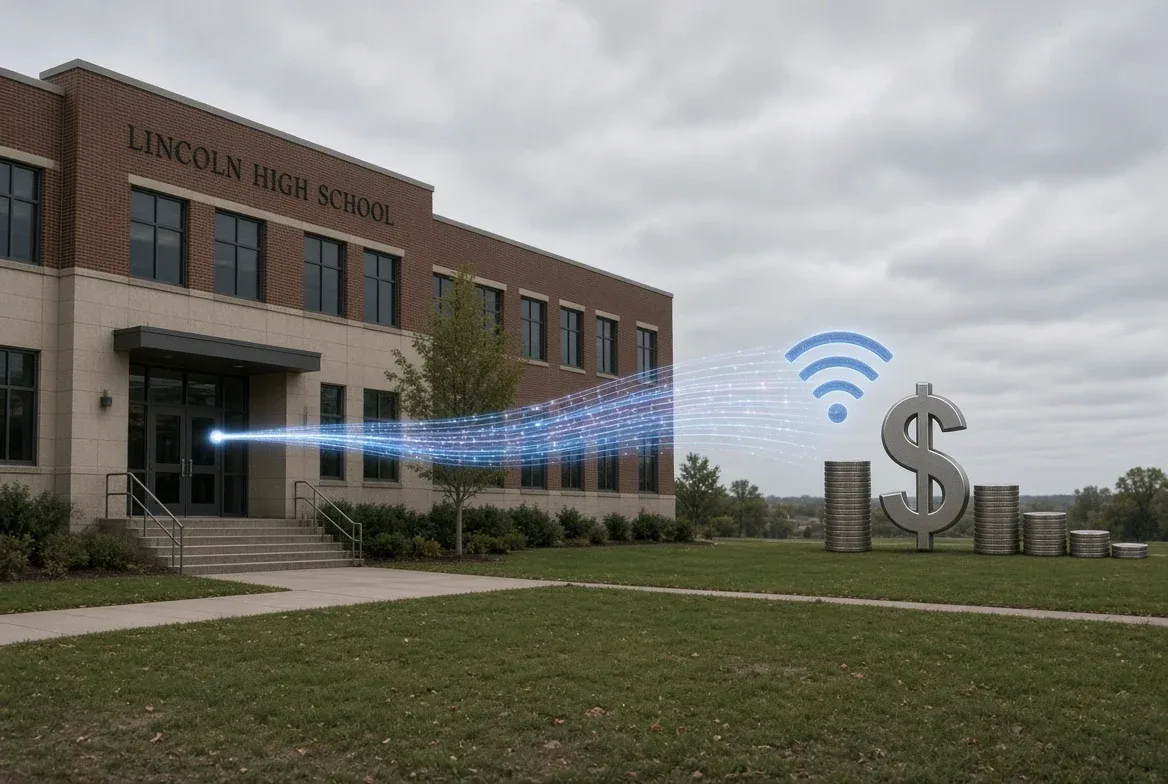
The Federal Communications Commission is reviewing E-Rate, the federal program that discounts internet and Wi-Fi service for schools and libraries and distributes roughly $3 billion a year, after Chairman Brendan Carr proposed examining the program on child screen-time grounds. The FCC opened the review on June 3, 2026, and voted June 25 to begin formal rulemaking, leaving districts uncertain about the funding stream many depend on for classroom connectivity.
The notice of proposed rulemaking that the FCC voted out states its goal is to better protect children using E-Rate-funded networks, including by limiting screen time, alongside stated aims of strengthening program integrity and streamlining administration. That framing has unsettled district technology directors, who point out that E-Rate money pays for network infrastructure, not the instructional software decisions that actually govern how much time students spend on screens.
What Is E-Rate and Who Relies on It?
E-Rate is administered by the Universal Service Administrative Company on the FCC's behalf and runs on a discount matrix tied to a school's poverty rate and urban-or-rural location. Under the program's own example, a library with a 90 percent discount rate that buys $1,000 in eligible broadband service pays $100 out of pocket while E-Rate covers the remaining $900, according to the Universal Service Administrative Company. Eligible spending covers internet access, telecommunications service, and related equipment such as Wi-Fi hardware and cabling. Every public and private K-12 school, along with libraries and multi-school consortia, can apply, and the program's funding year runs from July 1 to the following June 30. To draw on the discount, applicants must complete competitive bidding, select a service provider, apply during the annual filing window, and keep an active registration in the federal SAM.gov system so the Universal Service Administrative Company can invoice discounts directly, per the agency's own process guidance.
The dollars involved vary enormously by district size. In San Bernardino County, California, technology officials said their schools spend tens of thousands of dollars a month on internet service that E-Rate helps offset. In rural Alaska, the Alaska Gateway School District spends more than half a million dollars a year connecting just six schools, a cost that superintendent Patrick Mayer has said marks the difference between a 21st-century school and a 20th-century one.
Why Are School Officials Raising Alarms?
What Else Is the FCC Reviewing Besides Screen Time?
Screen time is the headline issue, but the rulemaking asks a wider set of questions. According to Education Week's account of the proceeding, the FCC is also soliciting comment on whether E-Rate effectively expands broadband access, whether it advances student learning while keeping students safe online, and whether program dollars are being spent appropriately. Chairman Carr has framed the effort around strengthening program integrity and streamlining administration, alongside the stated child-safety goal.
Supporters of the program argue that trimming or restructuring E-Rate is the wrong lever for addressing screen time, since schools rely on subsidized bandwidth for attendance systems, state testing platforms, and services for students with disabilities. Online exam components now run in 48 states, according to reporting on the review. Bob Bocher of the American Library Association has warned the rulemaking could load the program with enough new administrative burden that schools and libraries opt out on their own rather than through an explicit funding cut, an outcome he has characterized as shrinking the program "by design" without the FCC ever voting to cut it directly. Joey Wender of the Schools, Health, and Libraries Broadband Coalition went further, telling reporters the review “could result in the end of the E-rate program” and calling it an existential threat to school and library connectivity.
Not every voice in the debate is opposed to scrutiny. Josh Golin of the child-advocacy group Fairplay said the underlying concern about screen time is legitimate but should be addressed by strengthening local school technology policies rather than by pulling E-Rate funding. David Thurston, who oversees technology for San Bernardino County schools, described the program as functioning well and said any changes should be weighed against what districts stand to lose.
What Happens Next in the Review?
The FCC's process now moves into public comment: a 60-day window opens after the notice is formally published, followed by a 30-day reply period in which parties can respond to other filings. That timeline means the docket will likely stay open into the fall of 2026, well past the start of the current funding year, with any rule changes affecting E-Rate applications for the 2027-28 funding year at the earliest rather than the cycle already underway. Districts that budget around annual E-Rate discounts, particularly smaller and rural systems where the subsidy covers the bulk of connectivity costs, are watching the docket closely rather than assuming next year's application cycle will look like this year's.
For district finance offices, the review adds a second layer of uncertainty on top of an already tight budget picture following the expiration of pandemic-era emergency relief funds. Business officers who track federal funding streams say the safest near-term posture is to keep applying under current E-Rate rules while building contingency scenarios in case the discount matrix, eligible services list, or administrative requirements change for the funding year that starts in mid-2027. Vendors serving the K-12 broadband and Wi-Fi market face the same wait-and-see calculus, since a narrower program would shrink the subsidized purchasing that has underwritten a large share of school network upgrades since E-Rate's creation in 1996.
For a related edtech perspective, read FCC's New E-Rate Bidding Portal Sparks Pushback From School Groups.
For more context, read Trace any viral photo to its real source.
For more context, read What age does each platform say you have to be?.
For more context, read AI Volatility Forecasting: How It Works and Where It Fails.