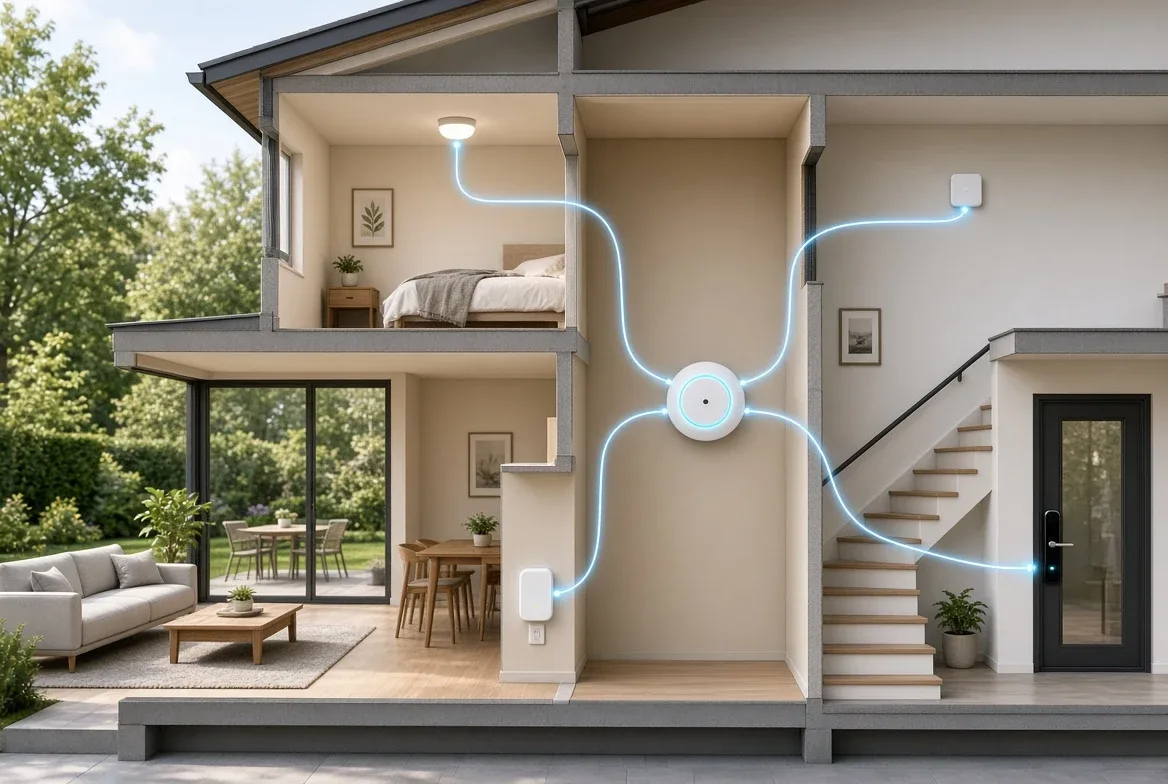
Matter is the connectivity standard built to make smart home gadgets from different brands work together without app-juggling or compatibility guesswork — but it doesn’t eliminate hubs, and it doesn’t cover every device yet, according to the Connectivity Standards Alliance (CSA), the industry group that maintains the standard.
If you’ve bought a smart plug, bulb, or sensor and wondered why it only talks to one app, this is the fix the industry agreed on. Matter is a shared language: a certified Matter device is supposed to work with Apple Home, Google Home, Amazon Alexa, and Samsung SmartThings without a brand-specific bridge, per the CSA. That’s the promise. The catch is that Matter runs on top of your existing network gear, and depending on the device, you may still need a Thread border router or a compatible hub to make it work.
Where did Matter come from?
Matter began life in 2019 as Project Connected Home over IP (Project CHIP), a joint effort by Amazon, Apple, Google, and the Zigbee Alliance (now the CSA) to stop smart home devices from being locked to a single ecosystem, as Engadget reported when the project was renamed Matter in 2021. More than 100 device makers backed the effort at the time. The CSA has described the Matter mark as “a seal of approval, taking the guesswork out of the purchasing process,” according to the group’s own announcement of the rebrand.
The first Matter-ready devices didn’t actually reach consumers until 2023. Eve Systems, a HomeKit-focused smart home brand, was among the earliest: it pushed Matter support to its Eve Energy plug, Eve Door & Window sensor, and Eve Motion sensor as free firmware updates tied to iOS and iPadOS 16.2, Engadget reported. Those updates immediately opened the devices to Samsung SmartThings, with Alexa and Google Home support arriving afterward — but Engadget noted that “you’ll only have simple functionality on other control platforms at first.”
How does Matter actually move data?
Matter doesn’t replace your Wi-Fi or your router. Instead, according to the CSA’s own technical explainer, it “leverages existing networking protocols already part of homes today like Wi-Fi and Thread,” and it can span “the Wi-Fi, Thread, and Ethernet physical networks within the home” to create what the CSA calls a Matter Fabric — effectively a private network where certified devices can find and talk to each other regardless of which of those three transports they use.
Thread is the piece that trips people up. It’s a low-power mesh networking protocol designed for battery-powered sensors and locks, and it requires a Thread Border Router — a small piece of hardware, often built into a smart speaker, smart display, or dedicated hub — to bridge Thread devices onto your home’s IP network, per the CSA. Without a border router present, a Thread-only Matter device won’t connect to anything.
Smart home hubs still matter under Matter. The CSA describes hubs as playing one or more roles in a Matter network: “Matter Administrator and Controller, and sometimes a Commissioner or Bridge.” A Bridge specifically lets non-Matter devices — including gear running older Zigbee or Z-Wave radios — join a Matter Fabric by translating between protocols, per the CSA. So a Matter label doesn’t mean hub-free; it means the hub requirement is now standardized instead of proprietary.
What changed in the newest version?
The CSA released Matter 1.4.2 on August 11, 2025, and the update is aimed largely at cost and security rather than flashy new features, per the CSA’s own release notes. The headline change is Wi-Fi-only commissioning: devices can now be set up over Wi-Fi using a method called Wi-Fi Unsynchronized Service Discovery, without needing a Bluetooth Low Energy radio on board. That matters for budget hardware — cutting the BLE radio lowers manufacturing cost, and the CSA says existing Wi-Fi products can add Matter support through a firmware update rather than new hardware.
Security got three additions in the same release, according to the CSA: vendor ID verification, which lets a device cryptographically confirm that the “admin” controlling it is really from the vendor it claims to be; Access Restriction Lists, meant to stop tampering with network infrastructure devices; and Certificate Revocation Lists, a standard way to revoke device certificates that have been compromised or retired.
The release also raised the ceiling on network capacity — the CSA’s notes specify Thread Border Routers now supporting more than 150 devices and Wi-Fi access points handling 100 simultaneous device associations — and it standardized behavior for robot vacuum cleaners for the first time. The CSA states that “Matter 1.4.2 maintains full backward compatibility,” though it also notes that some of the new capabilities need coordinated support across device, app, and hub software before they show up as features you can use.
What Matter still doesn’t guarantee
None of the sourced material here claims Matter has solved fragmentation completely. The CSA’s own materials frame 1.4.2 as incremental — security and cost fixes, not a rewrite — and note that several of its new capabilities depend on hub and app makers actually shipping support for them, which doesn’t happen on a single timeline across brands. Engadget’s 2023 coverage of the first Eve devices likewise flagged that early Matter support often meant “simple functionality” on non-primary platforms rather than full feature parity. If a listing says “Matter compatible,” that’s a real claim backed by certification — but it’s not a guarantee that every feature of a given device works identically on every app.
For a related setup perspective, read Does Matter Need a Hub? Here's What the Smart Home Standard Actually Requires.
For more context, read Advanced Technology: Devices and Smart.
For more context, read * Introduction *: Technology and Security.
For more context, read What age does each platform say you have to be?.