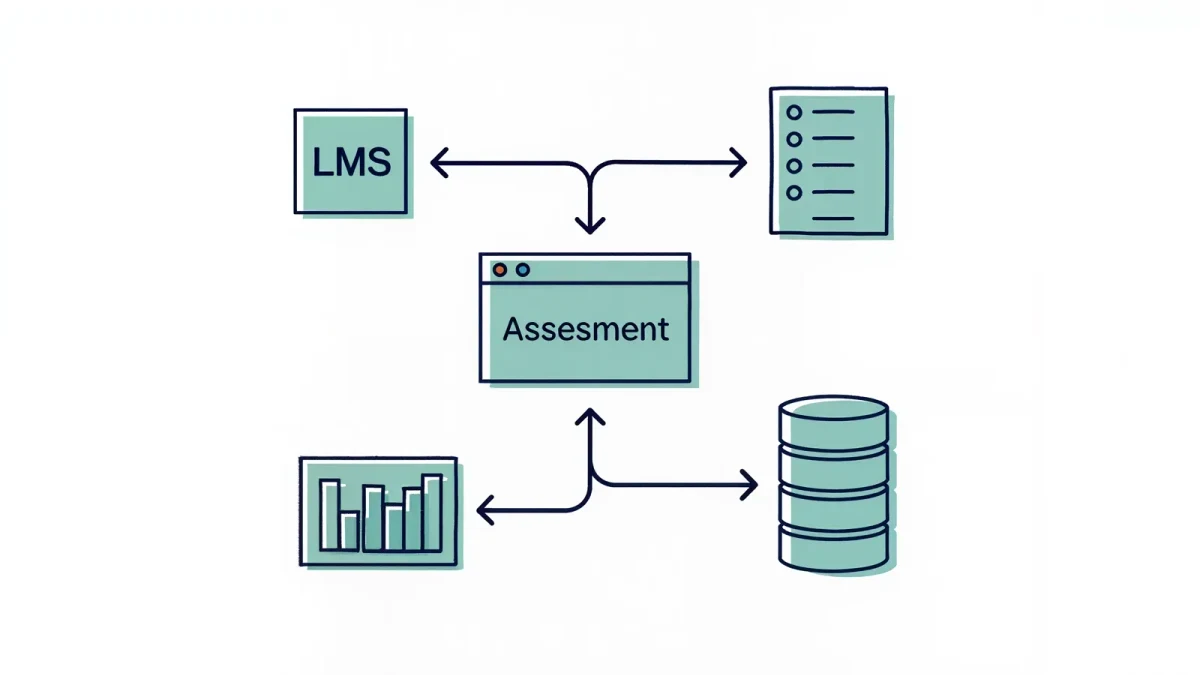
Why do some learning apps just work the week they are purchased, while others consume a semester of technician time? The difference is usually interoperability standards — specifically LTI, which lets a tool launch inside a district's learning management system, and One Roster, which feeds it correct class lists automatically. Both are maintained by the standards body 1EdTech, formerly IMS Global, and together they answer the two questions every instructional tool raises: how do students get in, and how do their grades get back. Districts that require standards certification in procurement spend their technology staff on teaching and learning instead of on CSV files, and that difference repeats at every term break for the life of the product.
What is LTI, in plain terms?
Learning Tools Interoperability is a launch protocol. When a student clicks an assignment link inside Canvas, Schoology, or Google Classroom-integrated platforms, LTI handles the handshake: it verifies the user's identity, passes them into the external tool, and establishes which course and role they arrived with — without a second login. The current generation, LTI 1.3, replaced the older shared-secret model with a modern security architecture built on open internet standards, and adds the Assignment and Grade Services that let scores flow back into the district gradebook automatically. For teachers, the visible benefit is simple: one login, one roster, and grades that appear where grades belong. For auditors, the benefit is that data flows through documented channels with names attached, rather than through exported spreadsheets with none.
What does One Roster do?
One Roster solves the unglamorous half of the problem: who is enrolled in what. A district's student information system — PowerSchool, Infinite Campus, Skyward — exports a standardized file describing schools, courses, enrollments, and staff, and any compliant vendor can consume it without custom engineering. Before standards like this, every September produced the same ritual: technology staff hand-building CSV exports for each of dozens of vendors, each with its own required column order, each breaking silently when a field changed. One Roster turns that ritual into a scheduled exchange, and the newer One Roster CSV specification made adoption cheaper for smaller vendors. The standard also encodes the privacy-relevant detail that a tool should only receive the students it serves — a data-minimization principle enforced by plumbing rather than by promises.
Why should procurement care about standards?
Because integration cost is hidden at purchase and permanent afterward. A tool without standards support costs a district real labor on day one and again at every schedule change, transfer, and semester boundary — costs that never appear in the license comparison. The standard procurement fix is a certification requirement: 1EdTech certifies products as LTI 1.3 conformant and One Roster compliant through a formal testing program, and districts can verify a vendor's certification status directly rather than accepting a sales claim. Districts that added a single line to their RFP templates — certified conformance with LTI 1.3 and One Roster, or a documented integration plan at the vendor's expense — report fewer mid-year integration emergencies. It is the rare contract clause that pays for itself before winter break.
What breaks when standards are skipped?
The failure modes are predictable. Manual rostering means a transferred student keeps appearing in the old class's tool for weeks, generating wrong assignments and confused parents. Non-compliant grade return means teachers re-key scores by hand, which is why the tool quietly stops being used by November. Homegrown single sign-on means every password reset lands on the helpdesk instead of the existing identity system. And from a privacy standpoint, ad hoc integrations usually transfer more data than necessary — full student lists, or fields nobody audited — because nobody designed them, they were assembled under deadline. Interoperability standards are, among other things, a privacy control: they define the minimum data that changes hands and give the district a conformance claim it can audit.
How does a district actually adopt them?
Start with the SIS, not the apps. Confirm that the student information system can export One Roster files, then require LTI 1.3 support in every new tool that touches instruction. Ask existing vendors for their certification status at renewal, and put non-conformant tools on a sunset list rather than renewing by inertia. Small districts without integration staff can lean on regional education service agencies and state-level programs that operate rostering on members' behalf — a service model that has spread precisely because the alternative consumed so many staff hours. The end state is boring, and that is the point: new tools that launch on schedule, rosters that update overnight, and technology directors whose October is no longer defined by spreadsheet archaeology.
How do LTI and One Roster work together at term start?
August is where the standards prove their worth. On the rostering side, the student information system publishes updated One Roster files overnight — new enrollments, schedule changes, withdrawals — and each compliant vendor ingests them automatically, so a student who moved districts on Tuesday is correctly seated in Wednesday's tool without a human touching either system. On the launch side, LTI 1.3 means the student's first click on the new tool authenticates them instantly through the district's identity provider, with no accounts to create and no passwords to distribute. The two standards cover the full first-week experience: the roster decides who appears, and the launch decides how they get in. Districts that have watched both run cleanly describe the start of school in terms that sound mundane and are in fact the entire point — nobody noticed, because nothing broke.