What should a district do when a learning tool disappears between semesters? Microsoft gave schools a live demonstration: the company retired Flip, the video-discussion platform formerly known as Flipgrid, on July 1, 2025, per educator-community documentation and replacement guides published that summer, and teachers who had built years of video assignments around it spent the following weeks rebuilding courses in Canva, Adobe Express, and Padlet. The shutdown was announced in advance, yet districts still lost instructional content — a reminder that notice is not the same as a transition plan. Every procurement file should contain the clauses that turn a shutdown from an emergency into a project.
What actually happened?
Flip was one of the most widely used classroom video tools in K-12 and higher education. Its retirement followed a familiar edtech pattern: an acquisition-era product folded as the owner consolidates, with integrations disabled first and full closure later. Per discussion threads from the Google Certified Educator community in 2025, vendors of competing video tools responded by offering free migration years — a clear signal that displaced Flip users represented a market event large enough to fight over. For districts, the lesson is not about Microsoft specifically. It is that a tool's popularity provides no contractual protection, and that exit terms are negotiated at signing, when the district still has leverage.
What changes for classes when a platform closes?
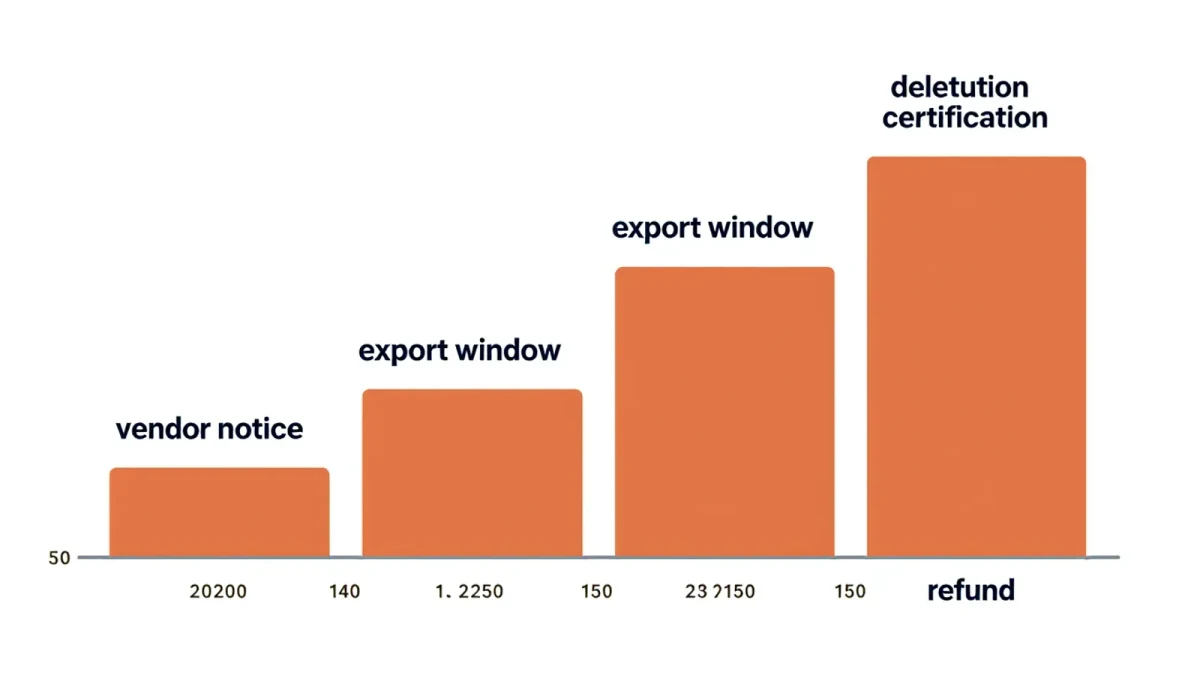
Three losses hit at once. Content: student video work and teacher-built activity libraries become orphaned unless the contract guarantees a machine-readable export window after termination. Rosters and workflows: classes built around the tool's assignment loop need a substitute within weeks, or the instructional practice dies entirely. Money: districts mid-subscription need pro-rated refunds, which vendors rarely volunteer. The contract clauses that address each are a post-termination export right (minimum 60–90 days, standard format), a wind-down service commitment, and a refund clause covering unused subscription terms when the discontinuation is the vendor's choice rather than the district's. Legal teams call these sunset provisions; technology directors should call them non-negotiable for any tool that touches graded student work.
What is the detail most districts miss?
Data deletion deadlines cut the other way, and almost everyone forgets them. A shutdown creates a privacy obligation, not just a logistics problem: once the tool is gone, the district loses the ability to verify that student recordings and metadata were actually deleted, unless the contract specifies deletion certification — a signed confirmation, within a defined number of days, that all district and student data has been destroyed. State student-privacy laws such as Illinois SOPPA already require operators to delete data on request; a sunset clause simply extends that duty to the shutdown scenario. The districts that asked Flip for deletion confirmations in summer 2025 closed the incident cleanly. The ones that did not will never know whether archived student video still sits in a decommissioned system. A one-paragraph clause, signed years earlier, is the difference.