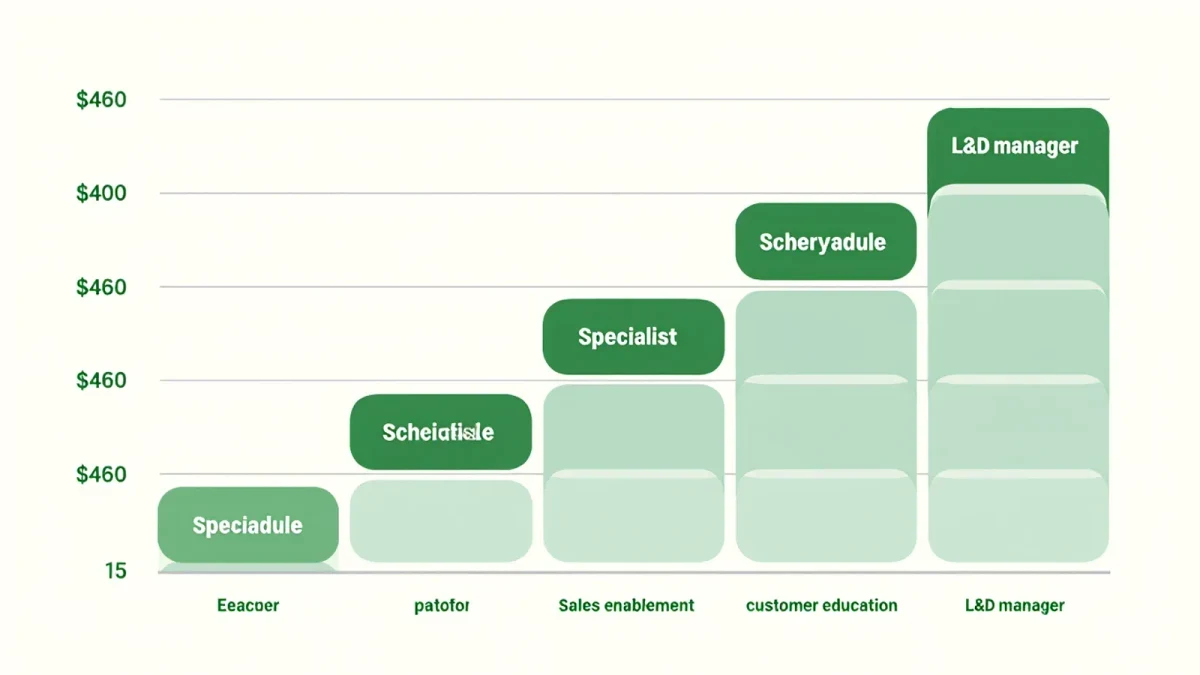
The federal category that covers most corporate training work — training and development specialists — had a median wage of $66,490 as of May 2024 BLS data, with training and development managers at a median of $124,640. Between those two points sits the realistic career arc for a teacher who moves into workplace learning: enter near the teacher median, then out-earn the classroom schedule within three to seven years by climbing to senior specialist, manager, or a lucrative niche like sales enablement or compliance training. The pay is real; so is the fact that the median specialist raise over teaching is small. The value is in the ceiling, not the entry point.
Which corporate training jobs can teachers actually get?
Teachers transfer into five main titles. Learning and development specialist is the generalist entry: building onboarding, running live sessions, maintaining the LMS. Training specialist in a functional domain — retail operations, healthcare onboarding, financial services — does the same work with a captive audience of new hires. Sales enablement specialist builds product and process training for revenue teams, and pays above the generalist track because it sits close to money. Technical trainer teaches software or equipment use, sometimes customers rather than employees. Customer education manager, common at software companies, builds the academies and certification programs teachers already know how to design. All five hire degree-agnostic teachers with evidence of adult facilitation.
| Role | Typical base (2024-2025) | Teacher fit |
|---|---|---|
| L&D / training specialist | $60,000-$85,000 | Direct transfer of lesson design and delivery |
| Sales enablement specialist | $75,000-$100,000 | Fast pace; bonus-adjacent |
| Technical trainer | $65,000-$95,000 | Needs product depth or willingness to learn it |
| Customer education manager | $80,000-$110,000 | Curriculum skills + edtech fluency |
| L&D manager / L&D director | $110,000-$160,000+ | Requires people or program management experience |
Where does the six-figure ceiling come from?
Three levers. Industry: finance, pharma, and tech pay 15-30 percent above retail, hospitality, and staffing for the same role — a bank compliance trainer and a restaurant-chain trainer do structurally similar jobs at very different bands. Function proximity: anything touching revenue (sales enablement, partner training, customer education that drives renewals) shares the commercial upside. Management: the BLS manager median of $124,640 reflects the step from building training to owning a program or team, usually reachable in four to eight years. Geography and remote-eligibility still bend the numbers, though 2023-2025 remote postings have standardized pay bands nationally at the mid-senior level. The ceiling, unlike teaching, has no step-and-lane ceiling — but it also has no automatic annual progression. Raises come from job-hopping and promotion, typically every two to three years.
What does a corporate trainer's week actually look like?
Expect a rhythm tied to the business calendar rather than an academic one. Peak seasons cluster around product launches, fiscal-year onboarding intakes, and annual compliance windows, when two or three live sessions a day plus rapid content edits become normal; quieter months shift toward needs analysis, curriculum revision, and learning-data reporting. Roughly half the week is building — writing storyboards, recording walkthroughs, updating slide decks in the brand template — and half is delivering, either in person at regional offices or on video calls that blur together. Trainers also inherit help-desk overflow: when employees cannot find the answer, the trainer writes the FAQ. Compared with teaching, there is no grading albatross and no parent correspondence, but there is also no summer recovery period, and performance is reviewed quarterly against adoption and completion metrics rather than once a year against a rubric. Teachers who miss the classroom's clear finish lines should ask in interviews how success is measured in the first ninety days — the answer reveals whether the role is respected or is a scheduling function.
How do teacher skills translate, and where are the gaps?
The strong half: instructional design (objectives, scaffolding, assessment), live facilitation for mixed audiences, curriculum mapping, LMS administration, and data-informed iteration. The gap half is the same trio almost every teacher-turned-trainer names: business vocabulary (KPIs, time-to-productivity, competency frameworks, Kirkpatrick evaluation), tools (Articulate suite, Zoom webinars at scale, an enterprise LMS like Workday or Docebo rather than Canvas), and stakeholder management with managers who treat training as a cost center. Certificates close the tools gap cheaply; reading and interview practice close the vocabulary gap; nothing closes the stakeholder gap but doing it. A realistic ramp is six months of preparation while teaching, which a modest investment — under $500 in courses and a portfolio site — typically covers.
Is the money better than teaching, honestly?
At entry, barely: $66,490 specialist median against a national teacher average near $66,000-$70,000 in recent NCES and NEA figures — essentially a wash, minus the pension and plus year-round pay. The case for the move is the arc, not the offer. A teacher who stays 25 years in a strong suburban district with pension accrual often out-earns a training specialist who plateaus; a teacher who reaches L&D manager in six years and director in twelve does not look back. Two populations benefit most: teachers in low-wage states, for whom even the specialist band is a raise, and teachers with energy for corporate navigation, without which the ceiling stays theoretical. If your main complaint about teaching is workload and disrespect rather than pay, weigh carefully: corporate training has its own unpaid-evenings season around launch cycles, and 'learner' buy-in is purchased politically rather than granted institutionally. The money is better on the right trajectory — just not automatically, and not on day one.