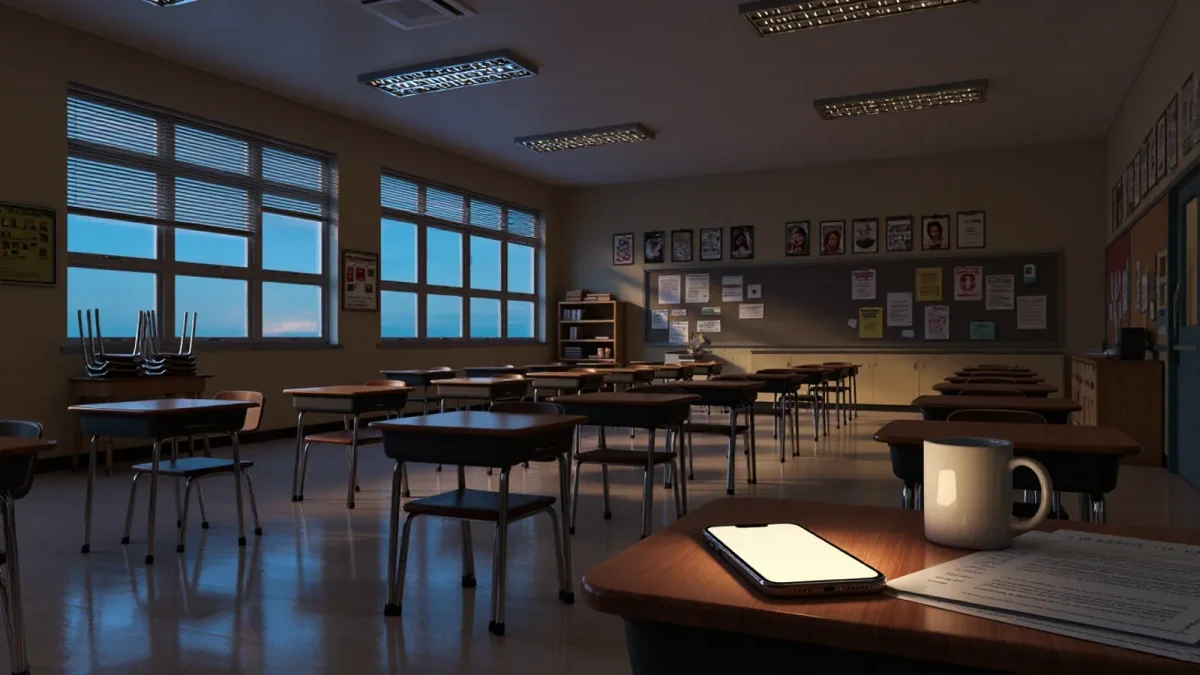
When Pew Research Center surveyed public K-12 teachers in 2024, 77 percent described their job as frequently stressful, and the unexamined driver behind much of that stress sits in a notification tray. District-wide messaging platforms promise families instant contact, and families have taken the promise literally: teachers across grade levels now describe answering parent messages after dinner, on weekends and during their own children's bedtimes, because nothing in the platform design says they should not.
How did messaging expectations change?
The technology rollout happened in three quiet steps. First, districts adopted single platforms for announcements, which was genuinely useful. Second, those platforms added two-way direct messaging, which converted every parent into a potential correspondent. Third, pandemic-era remote schooling trained both sides to expect same-day, often same-hour, replies, and the habit outlived the emergency that created it.
The volume is the new part. A teacher with 28 students and a messaging app is not receiving notes twice a year about report cards; they are fielding questions about homework details, lunch balances, seating disputes and grade postings, each individually reasonable and collectively unbounded. The 2024 Pew survey captured the surrounding pressure: 68 percent of teachers called the job overwhelming, and teachers repeatedly told Pew they want the public to understand the workload behind the role.
Parents are not villains in this story. Many work jobs where instant messaging is the norm, and schools marketed the apps with responsiveness language. The mismatch is structural: the platform is always on, the teacher is one person, and neither party negotiated the expectation.
What do district policies actually say?
Most districts have an acceptable-use or communication policy, and most of those policies are built for email-era cadences: replies within one or two business days. What teachers report in practice is a gap between the written policy and the informal norm, which in many buildings has drifted to same-evening responses because a fast reply once becomes an expected reply always.
Some districts have started to redraw the line explicitly. Common approaches include platform-level quiet hours that queue messages for morning delivery, stated response windows in staff handbooks, and scripted auto-replies that tell families when to expect an answer. The quiet-hours feature is the one teachers describe as genuinely protective, because it removes the individual's choice to answer at 9 p.m. rather than asking for willpower at 9 p.m.
The harder edge of the problem is tone, not timing. Pew's 2024 survey documented teachers feeling that parents' disagreements increasingly arrive as challenges to what is taught or how, and a text thread is a poor medium for either de-escalation or nuance. Buildings that moved substantive conflicts to phone calls or conferences, with messaging reserved for logistics, report calmer springs.
What does the research say about the workload?
The national workload data is directionally clear even when it does not isolate messaging. RAND's State of the American Teacher series has found teachers working well beyond contracted hours, with planning, grading and communication clustered in evenings. The NCES School Pulse Panel has tracked staffing pressure since the pandemic; Pew found 70 percent of teachers in 2024 calling their school understaffed, and every unfilled position distributes its parent communication onto whoever remains.
Messaging is rarely the largest workload item, but it has a distinctive quality: it is interrupt-driven, arrives without schedule, and carries an implicit emotional alarm, a message about a child feels urgent in a way a stack of grading does not. Teachers describe it as the work that follows them into the house.
What actually protects a teacher's evening?
The practices that survive contact with reality share a trait: they are collective, not individual. A teacher who unilaterally stops answering gets labeled unresponsive; a building that sets the norm together gets a policy. Effective combinations that districts used in 2024 and 2025 include a published response window of one school day, quiet hours configured centrally on the platform, a standing line in every syllabus and open-house presentation about what belongs on messaging versus what needs a call, and administrators willing to absorb the hostile thread when one arrives.
Leadership behavior is the variable teachers mention most. When a principal answers a parent's 8 p.m. message at 8:01, the building's real response window has just been reset regardless of what the handbook says. When the principal's own messages to staff respect evenings, the norm can hold.
None of this makes parent communication a burden to minimize. The evidence base on family engagement points the other way: informed families correlate with better attendance and outcomes. The goal is boundaries that make sustained engagement possible for eleven months rather than exhausting the relationship by October. A reply window of one school day is not a wall; it is the difference between a channel families can rely on for years and a teacher who quietly mutes it.
For more context, read The late work policy debate dividing faculty rooms.
For more context, read teacher social media policy.
For more context, read What the substitute shortage does to school culture.