The Montessori method is an educational approach that lets children choose their own work, learn through hands-on materials, and progress at their own pace in mixed-age classrooms. It was developed by Italian physician Maria Montessori more than a century ago, and it still runs on a simple bet: given a well-prepared environment and real freedom, children will teach themselves.
Here is the qualification every parent and teacher should know first. According to Wikipedia, the name "Montessori" is not trademarked, so a wide range of practices, schools, and materials operate under it. A school can call itself Montessori whether or not it follows the philosophy closely. That single fact shapes everything else about choosing or judging a Montessori program.
The method has outlasted a full cycle of American enthusiasm and dismissal, and it now runs in public and private schools on several continents. This primer explains where it came from, what a real Montessori classroom looks like, what the research does and does not establish, and how to tell a faithful program from a nameplate.
Where did the Montessori method come from?
Maria Montessori did not set out to run a school. She became one of the first women to earn a medical degree in Italy, graduating from the University of Rome in 1896, and she specialized in psychiatry and pediatrics. While visiting Rome's mental asylums during her training, she observed that children confined there needed more stimulation from their environment. That observation started everything.
She began studying educational theory in 1897, and in 1907 she opened her first classroom, the Casa dei Bambini, or Children's House, in a tenement building in Rome's San Lorenzo district. According to Simply Psychology, the school served low-income families, with roughly 50 to 60 children aged two to seven enrolled at the start. The children practiced practical tasks such as dressing, dusting, and gardening, alongside specially designed classroom materials.
Montessori called her work "scientific pedagogy," and she meant it. She documented her theories in a 1909 book later translated into English as The Montessori Method in 1912. The approach reached the United States by 1912 and spread quickly, but it also ran into organized resistance. A 1914 critical booklet by education professor William Heard Kilpatrick, The Montessori System Examined, limited its spread, and interest in the United States faded for decades. Montessori education returned to the country around 1960 and has since spread to thousands of American schools.
What actually happens in a Montessori classroom?
A Montessori classroom looks different from a conventional one, and the differences are the method. The American Montessori Society, one of the two major bodies associated with the approach, lists five components it considers essential to a quality program: properly trained teachers holding credentials for the level they teach, multi-age classrooms with a typical three-year age span, specially designed hands-on learning materials, student-directed work, and uninterrupted work periods.
Each component does specific work. Mixed-age classrooms let students learn from older peers and consolidate knowledge by helping younger ones. Uninterrupted work periods build concentration and time management, because students choose their own activities and work at their own pace. The materials are designed to teach through discovery rather than direct instruction.
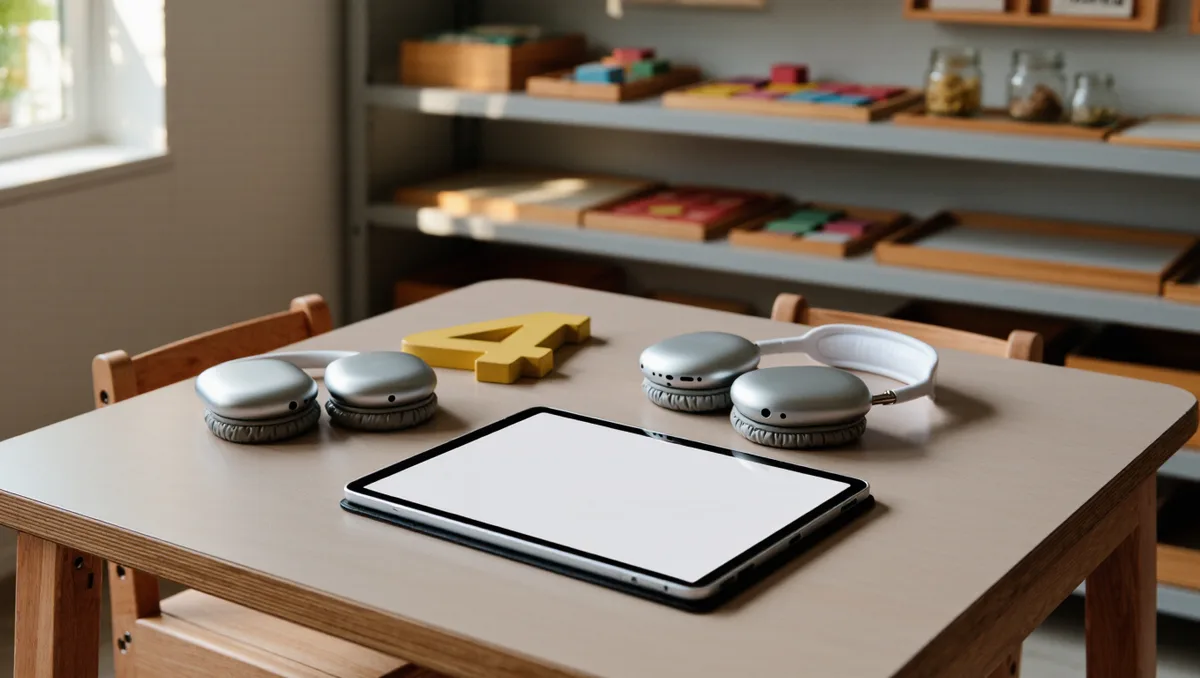
The room itself matters as much as the materials. As one detailed guide to the method's principles describes it, the "prepared environment" uses child-height shelves, child-scale furniture, and materials arranged from simple to complex, all reachable without adult help. Many materials are self-correcting, meaning they show the child when something is wrong without an adult pointing it out. The teacher's role shifts accordingly: less lecturing, more observing, guiding, and stepping in only when needed.
Grades and traditional tests sit uneasily in this model. The method discourages some conventional ways of measuring achievement, and assessment instead runs on systematic observation of each student's progress. That is a real philosophical difference, not a styling choice.
What does the research say about whether it works?
The honest answer: the evidence leans favorable, but the label outruns the evidence. According to Wikipedia, scientific studies of the Montessori method report generally favorable outcomes for students. That is a meaningful finding for a method this old and this widely used.
But here is the limit worth flagging. Because the name is unregulated, studies of "Montessori" schools may describe programs with very different levels of fidelity to the original model. A study of a high-fidelity program does not automatically validate a school that uses the name and little else. Families and districts evaluating a specific program should ask how closely it implements the core components, not just whether the word appears on the door. The same skepticism applies to any vendor claim about educational products, a problem we cover in our piece on what 'evidence-based' actually means when an edtech vendor says it. Readers following this should also see What 'evidence-based' actually means when an edtech vendor says it.
What the sources here did not establish is equally important. They do not show that Montessori outperforms every conventional alternative, and they do not quantify gains for any particular subject or age band. A school's own marketing is not independent evidence of impact. Treat outcome claims the way you would treat any vendor's pilot data: as the vendor's claim, not a verified result.
How can you tell a real Montessori program from a nameplate?
Practical steps, based on the components the major Montessori bodies themselves cite as essential:
- Ask about teacher credentials. In a quality program, teachers hold Montessori credentials for the specific age level they teach, covering the philosophy, the curriculum, and child development.
- Look for genuine mixed-age groupings. Early childhood classes typically span ages two-and-a-half to six, with further multi-age groupings at elementary and secondary levels.
- Check the work periods. Long, uninterrupted blocks of self-selected work are a defining feature, not an optional extra.
- Inspect the materials. Specially designed, hands-on, self-correcting materials are central. Rows of workbooks are not Montessori practice.
- Ask who accredits the school. Accreditation by a major Montessori body signals a program that has been evaluated against the philosophy, while the name alone signals nothing.
One more check matters for any school collecting student data, Montessori or otherwise: ask what learner information the school's software systems hold and who can access it. Data practices deserve the same scrutiny as pedagogy, a theme we cover in why FERPA's vendor exception decides what ed-tech can access.
What this means for parents and schools
The Montessori method is a coherent, century-old approach with a specific structure: trained teachers, mixed-age classrooms, self-paced hands-on materials, long work periods, and a prepared environment. The evidence for it is generally favorable, and its core ideas, especially self-direction and hands-on learning, keep reappearing in modern education debates and edtech products alike.
The open question is fidelity. The name carries no legal protection, so the method's quality depends entirely on how faithfully a given school implements it. For a family considering a Montessori program, the five components above are the checklist. For a district or school leader, the same checklist applies, plus the harder question of whether trained Montessori staff and materials fit the budget and the schedule. The method asks adults to prepare the environment and then step back. Judging a program asks them to do the opposite: look closely, and keep asking what the evidence actually covers.