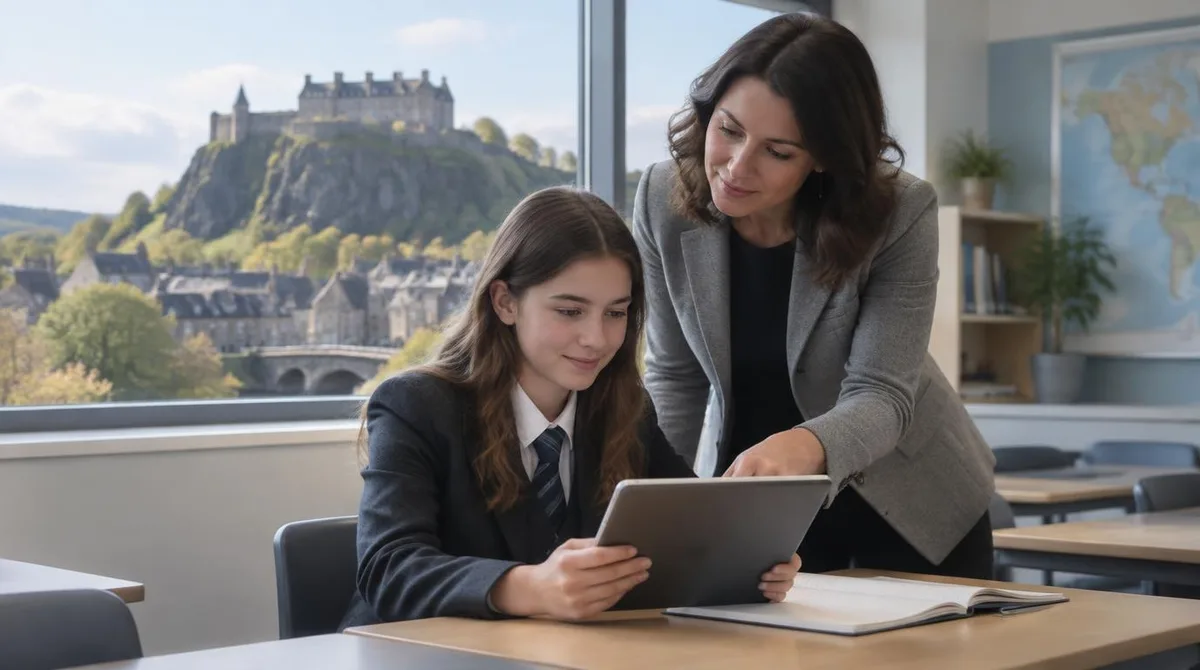
Immersive language learning technology is now in eight secondary schools across the UK and Ireland, and the honest answer to "should my school pay attention?" is yes — but as a study to follow, not a product to buy. According to the University of Stirling, the rollout forms part of a research programme called Transforming Cultures of Language-Learning (TransCoLL), led from Stirling, and it targets pupils in the early years of secondary education learning French.
The company behind the tool is ImmerseMe, a New Zealand-based platform the university describes as offering practice in realistic situations. The company says the platform works through VR headsets, computers and tablets. In this study, schools are using computers and tablets only — two schools in each of Scotland, Wales, Northern Ireland and Ireland — for a period of 30 months. That is the whole pitch: scripted practice scenarios, delivered on hardware most classrooms already own. This connects to our earlier piece, What 'evidence-based' actually means when an edtech vendor says it.
What is actually being studied, and by whom?
Language experts on the TransCoLL team will study learner motivation, progression and language anxiety, plus teachers' experiences of the technology. According to the University of Stirling, feedback comes from pupils and teachers through surveys and focus groups, exploring confidence and perceived competence in using the tool.
Professor Fiona Barclay, a Professor of French Studies at Stirling, is leading the study. She said: "We want more young people to experience the confidence and opportunity that learning another language can bring." She added that the ambition is "to turn that evidence into guidance for the people shaping language education."
Dr Marina Shapira, an expert in mixed and statistical methods for education, is working with Barclay on the programme. Partners include Cardiff University, Dublin City University, Queen's University Belfast and the University of London. The wider TransCoLL programme received £1.2 million from the Arts and Humanities Research Council, part of UK Research and Innovation, and was announced earlier this year.
Why the study exists at all
Participation in formal language-learning across the UK has fallen dramatically in recent decades, according to the university, with implications for international trade, diplomacy and social cohesion. TransCoLL examines the cultural, social and policy conditions that shape language-learning ecosystems in the UK's Celtic jurisdictions and in Ireland, aiming to inform recommendations for education and policy.
The classroom element focuses on French teaching in the early years of secondary education — areas previous studies have flagged as needing further investigation. So the study is not just about a tool; it is about whether immersive practice fits into classroom routines at the exact point where uptake tends to drop.
What teachers watching this rollout can actually do
The evidence does not yet show whether the technology improves learning outcomes — that is what the 30 months are for. But the study's design offers a ready-made checklist for any school considering immersive language tools in the meantime.
- Ask what is being measured. The Stirling team is tracking motivation, progression, language anxiety and teacher experience. Any vendor pitch to your school should be able to name its own measures — and say who collected them.
- Ask how confidence is assessed. This study uses surveys and focus groups on perceived competence. "Perceived" is the operative word; confidence gains are not the same as language gains.
- Check the hardware assumption. The rollout runs on computers and tablets, not headsets. If a supplier leads with VR hardware costs, that is a decision the evidence here does not yet support.
- Watch the timeline. Feedback arrives over 30 months, not in a term. A vendor promising classroom proof faster than a funded, multi-university study can produce it is telling you something.
For a deeper read on separating vendor claims from evidence, see what "evidence-based" actually means when an edtech vendor says it. And because pilots of this kind often never turn into district contracts, it is worth knowing why district edtech pilots rarely become contracts before treating any rollout as a sign of settled adoption.
What the sources do not establish yet
No learning-outcome results exist yet. The study has not published findings on whether ImmerseMe improves French proficiency, and the university release does not name pricing, the schools involved, or how the platform handles pupil data. Those gaps matter for any school making a purchase decision now.
The realistic next development is the study's own feedback cycle: surveys and focus groups with pupils and teachers, feeding into guidance for the people shaping language education. Until then, the sensible position is the one the evidence supports — follow the study, note its measures, and hold purchase decisions until the 30 months produce findings worth acting on.