Does switching learning management systems help someone learn? Only if the district survives the switch, and many underestimate it. Districts that have migrated — from older platforms to Canvas, Google Classroom-plus-administrative layers, or Schoology transitions after its 2023-ish sunset announcements — consistently report the same lesson: the license is the cheap part. CoSN benchmarking and district case reports through 2024 put the full first-year cost of an LMS migration at three to five times the annual subscription once content migration, integration rebuilding, training, and support surge are included. A switch priced at $60,000 in licenses can realistically consume $250,000 of district capacity.
Why do districts switch anyway?
The triggers are usually rational. A vendor discontinues a product, as happened to districts anchored to platforms retired in the mid-2020s. A merger shifts pricing or roadmap priorities. State requirements for grade passback or interoperability expose an old system's limits. Security incidents or aging architectures push risk-averse boards to act. The mistake is not switching; it is treating the decision as a procurement event rather than a two-year organizational project. Districts that frame it as a project budget realistically; districts that frame it as a purchase discover the difference in October.
Where does the money actually go?
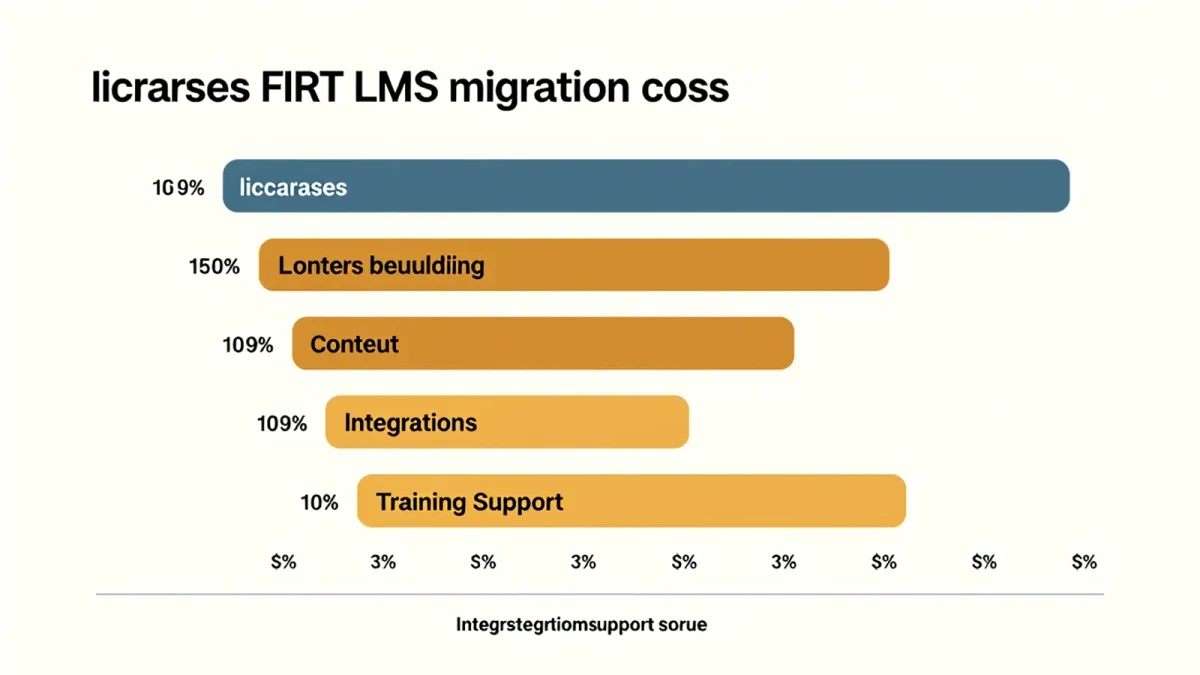
The visible line is the subscription. The invisible lines are larger. Content migration is the biggest: years of courses, quizzes, and embedded third-party tools rarely move cleanly, because LTI links break, quiz formats differ, and legacy SCORM packages behave inconsistently. Districts commonly rebuild rather than migrate the majority of active course content, and that labor belongs to teachers who already have jobs. Integration work is second: student information system rostering, single sign-on, grade passback, and parent portal connections each need rebuilding and testing. Training and support surge is third — a migration year typically doubles helpdesk volume for a quarter. Add data-archival obligations for records on the old system, which state retention schedules may require for years after the platform is gone.
| Cost category | Typical share of first-year migration cost | Often in the budget? |
|---|---|---|
| New platform licenses | 20–30% | Yes |
| Content migration and rebuilding | 25–35% | Rarely |
| Integrations (SIS, SSO, passback) | 15–20% | Sometimes |
| Training and summer institute time | 15–25% | Partially |
| Support surge and archival | 10–15% | Rarely |
What breaks that districts never expect?
Three breaks recur in district post-mortems. First, embedded third-party tools: a science course built around simulations, formative tools, and publisher content is a web of LTI links, and each one needs reconnection and re-testing by someone who understands the course. Second, special education workflows — many IEP-related accommodations live quietly inside the old LMS's assignment-extension and alternative-materials settings, and their loss surfaces as compliance problems in November. Third, family muscle memory: parents who finally learned the old parent portal must relearn a new one, and districts that skip family communication see engagement metrics drop for a semester. Each break is survivable; none appears in the vendor's implementation checklist.
How can a district switch more cheaply?
Start earlier than feels reasonable: a spring decision for a following-year launch means two full semesters of preparation, not one frantic summer. Standardize before migrating — move courses to a common template so you migrate a clean pattern, not five years of individual habits. Use standards deliberately: content authored to Common Cartridge or LTI-compatible tools ports better than proprietary formats, and that argument compounds every future migration. Pay teachers for rebuilding time explicitly, in contractually clean stipends or release time, because uncompensated migration work is how districts breed resentment and shadow IT. And run both systems in parallel for one term with a named cutoff date — indefinite dual systems cost more than either platform.
What should the contract say?
Require the incoming vendor to quote data migration scope in writing, including formats and what will not transfer. Require export rights to a documented, machine-readable format for the life of the relationship, and pre-negotiate exit data delivery — a full export at no additional charge within a defined window after termination. Require LTI 1.3 and One Roster support so future integrations survive. For the outgoing vendor, require archival access to records for the period state retention rules demand. Districts that negotiate exit terms at entry get them; districts that ask at exit get invoices. The privacy office should also be at the table for the new contract, because an LMS holds student work, grades, and communication records — core FERPA records — and the migration moment is when data tends to leak into unmanaged copies.
When is it better not to switch?
If the current system meets instructional needs, integrates with the SIS, and its vendor is stable, most hidden-cost analyses favor staying. The case to switch rests on concrete failures — a sunsetting product, unmet compliance needs, or integration dead ends — not on a sales presentation's comparison chart. Boards should ask the technology director one question before voting: show me the two-year total, including teacher time. If the answer only includes licenses, the analysis is not finished.
A final, underused tactic is a migration dry run with a single department. Choose a department with typical, not exceptional, courses — a middle school math team is a common choice — and move its full course load to the new platform one semester early. Every ugly surprise, from broken quiz banks to gradebook passback quirks, surfaces while the stakes are small and the old system still works. The department's teachers become the district's trainers in the summer institute, which is cheaper and more credible than vendor-led sessions. Districts that skip this step meet the same surprises in August with every teacher watching. The dry run costs one semester of one department's patience; skipping it costs a year of goodwill districtwide.