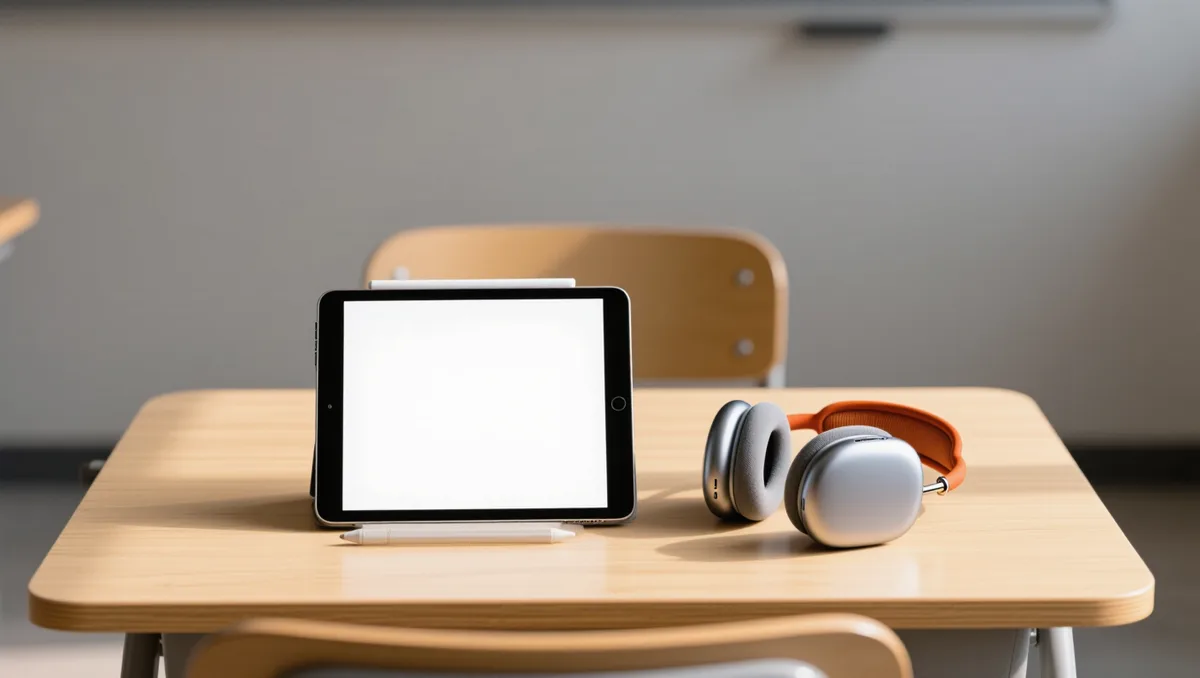
For handwriting-heavy subjects like math and chemistry, stylus accuracy is mostly about three things: how fast the pen draws (latency), how well the tablet ignores a resting hand (palm rejection), and how consistently the tip tracks the screen. On those measures, the current iPad lineup with Apple Pencil and Samsung's Galaxy Tab line with the S Pen are the safest bets. Budget Android tablets without a bundled stylus are the riskiest, because palm rejection and pen support vary widely and are often absent.
That judgment rests on vendor documentation and independent testing rather than classroom trials — nobody has published a rigorous study tying stylus latency figures to chemistry exam scores. What the evidence does support is a hardware picture. According to PCMag, whose editors have tested and rated tablets since the original iPad debuted in 2010, the entry-level iPad now carries an 11-inch display, works with the Apple Pencil, and remains the most affordable iPad; the midrange Samsung Galaxy Tab S10 FE+ and the iPad Pro also hold Editors' Choice standing in its current roundup.
Price matters as much as pen quality in a school purchase. PCMag's roundup also highlights the Lenovo Idea Tab Pro, an Android slate under $400 that includes a stylus and a fast charger in the box — a rare bundling at that price. On the resale side, a Walmart listing shows an open-box Samsung Galaxy Tab S10 Lite with an S Pen included at around $202, well below what a new iPad plus Apple Pencil typically costs (Walmart). Those are list prices, not procurement contracts, but they frame the trade-off.
What does stylus latency actually do to math work?
Latency is the delay between the pen touching the glass and the ink appearing. When it is low, the line seems to follow the tip, and students write naturally. When it is high, the ink lags behind, and handwriting gets slower and less legible — a real problem when a student is transcribing a multi-step derivation in real time.
The practical point for buyers: latency is a function of the whole system — screen, digitizer, and software — not just the pen. Vendor spec sheets tout millisecond figures, but those numbers are the company says, not an independent measure, and they rarely carry an as-of date you can hold them to. The reliable signal is simpler. Devices whose makers design the pen, the screen, and the note-taking software together — Apple with the iPad and Pencil, Samsung with Galaxy Tabs and the S Pen — tend to deliver consistent pen behavior. Devices that merely "support" a generic stylus tend not to.
For teachers, latency shows up in grading. If a student's scanned work is smudged or the strokes are visibly delayed and redrawn, reading a solution becomes an archaeology exercise. A consistent pen experience on both ends keeps the workflow ordinary.
Why palm rejection decides chemistry notes
Palm rejection is the tablet's ability to ignore the side of your hand while the pen writes. Without it, every paragraph of organic chemistry notes sprouts stray marks where the hand rested. Students then adopt workarounds — hovering the hand, writing in awkward postures — that slow them down and, over a semester, make tablet note-taking feel worse than paper.
Here is the honest gap in the evidence: palm rejection quality is almost never quantified independently. It appears in reviews as an impression, not a measurement. The defensible buying rule is therefore indirect. Pick platforms where the pen is a first-class input — Apple Pencil on iPad, S Pen on Samsung — because those ecosystems build rejection into the OS layer, and pick note-taking apps known to handle it well. Treat any budget tablet whose listing does not even mention stylus support as a device for reading and video, not for writing.
Does pressure sensitivity matter outside art class?
Less than the marketing suggests, and more than zero. Pressure sensitivity lets stroke weight vary with force. In art it is essential. In math and science it is mainly about emphasis — underlining a key step, sketching a force diagram with heavier arrows — and about how naturally the pen feels.
What matters more for these subjects is line fidelity: does a straight line stay straight, does a small subscript stay legible, does the ink land where the tip touched. Those are functions of digitizer resolution and software, and they are the qualities that decide whether a teacher can read a student's equilibrium-constant calculation at 11 p.m. without squinting.
Our analysis: schools shopping on pressure-sensitivity spec sheets are optimizing the wrong variable. Ask instead whether the vendor's own note-taking app renders handwriting cleanly and whether student work exports in a format your grading workflow can read.
What the three platforms actually cost
The price spread across ecosystems is wide, and the pen is often the hidden line item.
| Platform | Stylus situation | Price signal from sources |
|---|---|---|
| Apple iPad | Apple Pencil sold separately; broad app support | Entry iPad is the most affordable iPad in PCMag's current roundup; Pencil adds cost |
| Android (Samsung) | S Pen bundled on Galaxy Tab lines | Open-box Galaxy Tab S10 Lite with S Pen listed near $202 at Walmart |
| Android (other) | Varies; Lenovo Idea Tab Pro includes one | Idea Tab Pro under $400 with stylus included, per PCMag |
| Budget Android | Often no pen support at all | Walmart lists many sub-$150 Android tablets; the Fire HD 10, under $150, is a media tablet, not a writing one |
Windows tablets are, as PCMag puts it, an entirely different category — closer to laptops with pen input, and priced accordingly. They suit a district already standardized on Windows, but they are rarely the value pick for a note-taking cart.
Two cautions from the same evidence. First, the Amazon Fire HD 10 earns PCMag's praise as an entertainment value under $150, but it runs Amazon's Fire OS with a limited app selection — the wrong tool for a math department. Second, cheap Android listings frequently omit stylus specifications entirely; absence of a claim is a claim of sorts.
How should a school decide?
Practical steps, in order:
- Map the device to the subject, not the reverse. Handwriting-heavy courses need pen-first hardware. Consumption-heavy courses do not.
- Check the pen ecosystem before the device. A bundled pen (S Pen, Lenovo's included stylus) removes an accessory purchase and a compatibility risk.
- Verify app support for your grading workflow. The best pen is useless if student work cannot export to your LMS in readable form. Districts weighing platform switching already know how expensive that mistake is — see the hidden costs of switching learning management systems.
- Count device management, not just purchase price. For iPad fleets, management overhead is a real cost driver, as our comparison of MDM platforms for school iPads shows.
- Budget for the whole lifecycle. A tablet program's true cost includes support and replacement horizons, the same discipline we applied to Chromebook lifecycle costs.
And keep expectations about outcomes modest. Hardware enables practice; it does not produce learning by itself. The evidence on software-driven math gains, reviewed in what the studies on adaptive math software actually show, is a useful corrective to any claim that a better pen will lift scores.
Where the evidence runs out
What the sources establish: which devices bundle pens, roughly what they cost, and which platforms treat stylus input as a core feature. What they do not establish is any measured link between stylus latency, palm rejection, or pressure sensitivity and student learning outcomes in math or science. No independent study in the supplied evidence makes that connection, and vendors do not publish classroom data.
The closing verdict, segmented by reader: for a one-to-one district standardizing on a single platform, iPad plus Apple Pencil offers the most consistent pen experience at the highest price, and Samsung Galaxy Tab plus S Pen offers most of that consistency with the pen in the box. For a single classroom or department, the Lenovo Idea Tab Pro's bundled stylus under $400 is the value case, provided the note-taking app fits your workflow. For anyone eyeing sub-$150 Android slates for writing-heavy courses: don't. That's the whole verdict.